

On December 1, 2025, Senator Bernie Moreno (R-OH) introduced the Exclusive Citizenship Act of 2025. The bill would prohibit any person from simultaneously holding U.S. citizenship and citizenship of another country. But in the last decades an increasing number of countries changed their legislations and accepted dual citizenship and 76% of 200 countries tolerate it.
The main provisions of Sen. Moreno’s proposal include:
- The requirement that existing dual citizens would have one year to renounce all foreign citizenships or relinquish U.S. citizenship.
- Failing to renounce foreign citizenship within the one-year period would count as a voluntary relinquishment of U.S. citizenship under Section 349(a) of the Immigration and Nationality Act. (8 U.S.C. 1481(a)
- The voluntary acquisition of a foreign citizenship after enactment would trigger immediate loss of U.S. citizenship.
The proposal clashes with the growing acceptance of dual citizenship by many states.
Dual citizenship is in fact on the rise: 76% of 200 countries tolerate it. Until the 1960s, dual citizenship was viewed as problematic in international law and by most states, but now ever more countries accept dual citizenship as an unavoidable consequence of gender equality (mothers as well as fathers can transmit their citizenship to the child by descent) and transnational migration (migrants and their children acquire the citizenship of the destination country while retaining the citizenship of the origin country).
As a result, ever fewer countries strip people of their citizenship when they acquire another, and ever more destination countries no longer require migrants to renounce their previous citizenship to naturalise. (Migration Data Portal)
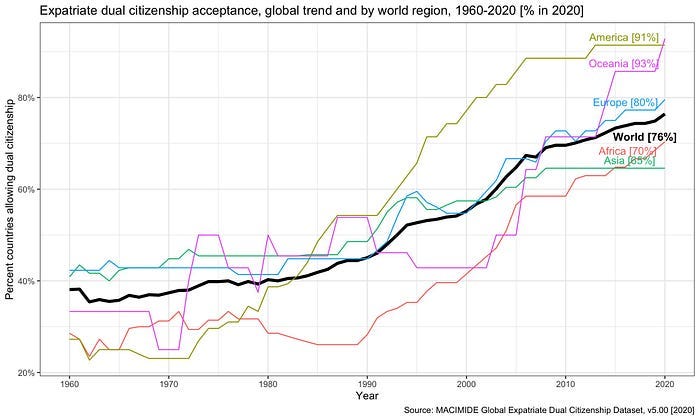
By 2020, 76 per cent of 200 countries examined tolerate dual citizenship for emigrants, allowing their citizens to voluntarily acquire the citizenship of another country without automatically losing their citizenship of origin.
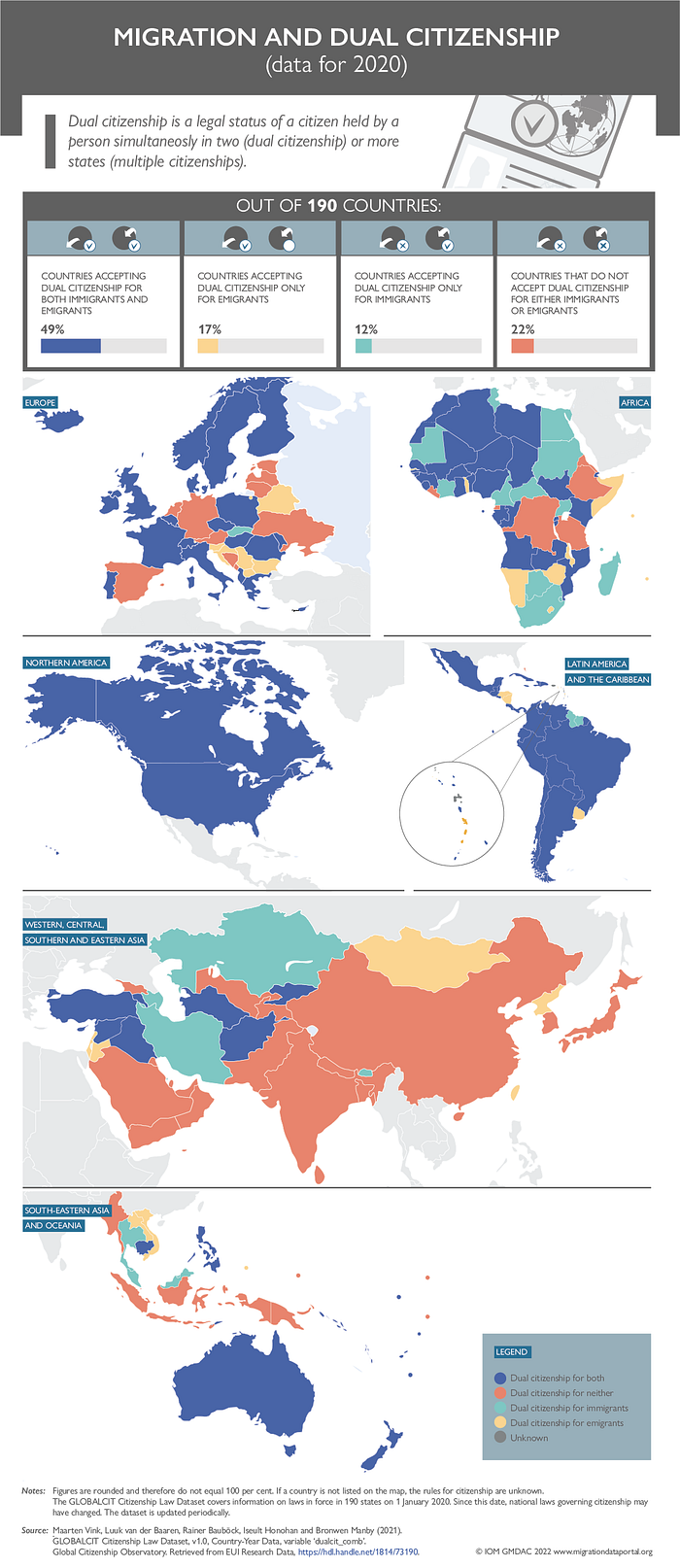
Dual citizenship acceptance for emigrants has progressed faster in the Americas, Europe and Oceania and more slowly in Africa and Asia (Vink et al, 2019). 61 per cent do not require immigrants to renounce their previous citizenship as a condition for naturalisation and 49 per cent tolerate dual citizenship for both their diasporas and immigrants. Among the 22 per cent of countries that reject dual citizenship for either group, many still allow it when a person acquires it at birth rather than through naturalisation (Van der Baaren and Vink, 2021).
GLOBALCIT Citizenship Law Dataset
GLOBALCIT’s dataset on modes of acquisition and loss of citizenship provides standardised descriptions of citizenship laws that allow for international comparison. The dataset breaks down citizenship laws into 28 modes of acquiring citizenship by birth or naturalisation and 15 modes of losing citizenship by renunciation or withdrawal. The GLOBALCIT Citizenship Law Dataset, v1.0 covers information on legislation in force in 190 states on 1 January 2020.
Disclaimer: The information provided in this article (i) does not, and is not intended to, constitute legal advice; (ii) is for general informational purposes only and may not reflect the most up-to-date legal or other information; and (iii) may include links to third-party websites. Such links are only for the convenience of the reader; (iv) readers should contact their attorney to obtain advice with respect to any particular legal matter.


